Go to Blogger edit html and find these sentences.Now replace these sentences with your own descriptions.This theme is Bloggerized by NewBloggerThemes.com.
Go to Blogger edit html and find these sentences.Now replace these sentences with your own descriptions.This theme is Bloggerized by NewBloggerThemes.com.
Go to Blogger edit html and find these sentences.Now replace these sentences with your own descriptions.This theme is Bloggerized by NewBloggerThemes.com.
Go to Blogger edit html and find these sentences.Now replace these sentences with your own descriptions.This theme is Bloggerized by NewBloggerThemes.com.
Go to Blogger edit html and find these sentences.Now replace these sentences with your own descriptions.This theme is Bloggerized by NewBloggerThemes.com.
Huawei has just unveiled the Mate Xs, its second folding smartphone. Sold at 2,499 euros, this unusual device has an 8-inch screen that can fold in two. One year after a Mate Xthat was never released in Europe, Huawei has just unveiled the Mate Xs, an improved version of its first folding smartphone. The main new features of this new device are a reinforced screen and better features, including the integration of the Kirin 990 5G processor. However, like the Mate 30 Pro, it is deprived of Google services.
A screen as big as ever
In fact, the Huawei Mate Xs is only a very slight evolution of the Mate Xs. It still offers a surface area of 8 inches when unfolded and allows you to choose between 6.6 and 6.38 inches when folded. Yes, unlike Samsung, Huawei always folds its smartphone with both screen halves facing outwards, allowing the mobile to be used on both sides.
This also has the advantage of making the fold almost invisible (it's normal, the curvature is less pronounced) but the disadvantage of exposing the screen to scratches permanently. It is not protected in a pocket. Aware of this problem, Huawei says he has improved the durability of his folding smartphone. The screen would be much stronger while its hinge, the mechanical part that allows it to fold, is now protected by a plastic end cap. So nothing can get inside. Still, fold and unfold the Mate Xs still inspires little confidence when in use.
You can hear slight crackling noises and you almost think you're damaging the screen (of course you're not). The Chinese brand clearly lags behind Samsung in this regard, and with its Galaxy Z Flip, the Mate Xs really does convey a sense of solidity. This folding smartphone is so wide that it's difficult to hold it in one hand, which greatly reduces its appeal. Only time will tell whether or not the Mate Xs are practical to use.
Nice improvements
As you can see, the Huawei Mate Xs looks like a Mate X. It is in the components that the Chinese brand has made the most changes.
The first change, the Kirin 990 processor replaces the Kirin 980. Compatible 5G, the latter will offer better throughput according to Huawei while consuming less energy. It will also provide similar performance to the Huawei Mate 30 Pro, the latest high-end smartphone of the Chinese brand. Another advantage of the Mate Xs is that the smartphone supports 55W ultra-fast recharging and can, therefore, recharge 85% of its battery in just 30 minutes. No other folding smartphone today supports such a function. Finally, the Mate Xs wins most at the camera level. The mobile takes over the quad-camera module of the P30 Pro, with the exception of its periscopic zoom. The smartphone's 40 Mpix SuperSensing sensor (which excels at night) is supported by a telephoto lens with x3 zoom (in 8 Mpix), an ultra-wide-angle lens attached to a 16 Mpix sensor and a ToF sensor. Finally, the latest enhancements to Mate Xs are software. As on an iPad or Galaxy Fold, you can drag an application icon to the left or right of the screen to launch a split display.
Although promising, this system, unfortunately, lacks ergonomics at the moment. We've had trouble using it.
Unfortunately, the Huawei Mate Xs also costs more than its predecessor. Huawei has decided to market its product at 2499 euros (with 512 GB of storage), an increase of 200 euros. This makes this Chinese folding smartphone the most expensive on the market. A crowning achievement has given the absence of Google services. In this configuration, it is hard to imagine the brand selling many of them outside China. The Mate Xs should be available in the coming weeks.
Realme unveils the X50 Pro, a high-end, 5G smartphone with a... 599 euros
Compatible with 5G, Realme's new high-end smartphone - Realme X50 Pro - impresses with its features. It is one of the first mobile phones to be equipped with the Snapdragon 865 processor. 90 Hz display, ultra-fast recharge, 5G compatibility, Wi-Fi 6 and Snapdragon 865 support... The technical specifications of Realme's latest product, the X50 Pro 5G, are impressive. Just announced in Madrid (its announcement was initially planned at the MWC in Barcelona), the new smartphone from the Chinese brand embeds the latest technology at a very aggressive price. Realme, a company in the BBK Electronics group (Oppo, OnePlus and Vivo), is aiming to make a name for itself in 2020.
Not much is missing
Originally intended for the entry-level market, the Realme brand has for some time been focusing on the high-end sector. Its X2 Pro, released at the end of 2019, was indeed a flagship killer in the OnePlus line. The new X50 Pro 5G takes it one step further by incorporating Qualcomm's Snapdragon 865 processor, a latest-generation component that few manufacturers currently use. Another advantage of the Realme X50 Pro is that the smartphone uses SuperDart fast charging technology (a renowned version of Oppo's SuperVOOC 2.0). Connected to a 65W high-power charger, the smartphone can be fully charged in... 35 minutes. This feat is all the more impressive since it has two batteries with a total capacity of 4200 mAh, which should give it a very good autonomy.
It should be noted that if the brand has separated the battery of its X50 Pro into two parts, it is precisely to allow it not to heat up too much during recharging. Aesthetically, the Realme X50 Pro looks very successful. Equipped with a 6.44-inch OLED screen in 20:9 format, it hides its two front cameras (wide-angle and ultra-wide-angle) in a punch, which allows it to avoid the notch. With a refresh rate of 90 Hz, its screen should offer better fluidity than on most other smartphones. However, Realme does not take the 120 Hz bet as Samsung and OnePlus have done.
On the back of the Realme, X50 Pro 5G is a quad-camera module. The main lens of the smartphone, attached to a 64 Mpix sensor, opens at f/1.7 and should take excellent night shots according to the company (we're already looking forward to checking it out).
The mobile also has an ultra-wide-angle (with an 8 Mpix sensor) and a telephoto lens (12 Mpix sensor) with no optical magnification coefficient, Realme preferring to communicate on a "hybrid zoom x20", which doesn't mean much.
Finally, the last lens is the most original, it is a monochrome camera dedicated to portraits. Starting at 599 euros, the Realme X50 Pro 5G is one of the cheapest 5G smartphones on the market today. The most premium version of the mobile, with 12 GB RAM and 256 GB storage, costs 749 euros, making it Realme's most expensive smartphone. The X50 Pro range is expected to be available in Europe in April.
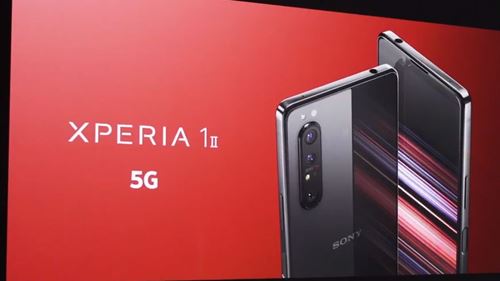
Sony Xperia 1 II: Sony's 21:9 smartphone upgrades to 5G and draws inspiration from its photo hybrids
The Japanese unveil its new flagship, the Sony Xperia 1 II 5G smartphone becomes the manufacturer's top-of-the-line model. The cancellation of the MWC in Barcelona will not have been the end of the Sony announcements of this February 24th. The nostalgia of a 3.5mm jack port found again, combined with the much-hoped-for 5G connectivity, is the recipe chosen by Sony for its new high-end smartphone. The Xperia 1 II 5G (pronounced Mark II, as in the photo) is in line with the huge 21:9 smartphone, all in length, released last year. It's the first 5G-compatible smartphone from the Japanese manufacturer for Europe and is a fairly significant evolution of the Xperia 1.
On the technical front first, Sony's newest addition borrows the classic features of a high-end 2020 Android smartphone with a Qualcomm Snapdragon 865 processor, a large 6.5-inch 4K HDROLED display and a more powerful battery that reaches 4,000 mAh. Sony seems to have revised its copy for this Mark II. Last year, its premium Xperia had convinced us on many points, with the exception of its 4K screen, which is ultra resource-hungry and quite disastrous for the battery life. The 2020 model year remains in 21:9 format, which is particularly appreciated for video, but in addition to the higher capacity battery, Sony also announces a refresh rate "equivalent to 90 Hz".
So it's not a 90 Hz screen as rumors have it... which could be an advantage in the end for battery life.
A few drops of Alpha in the Xperia...
It is on the photo part that this Xperia 1 seems to offer the most beautiful promises. In this age of 108-megapixel sensors, Sony is taking a significantly different tune with a triple 12-megapixel module that might seem "outdated" technically, if it didn't come with a dose of in-house know-how from the Alpha range, Japan's hybrid cameras. First of all, the triple module embeds Zeiss optics (as on DSLRs) and a 3D iToF sensor. Second, Sony promises 20 fps to burst shooting with AF/AE calculation (i.e. automatic autofocus and exposure measurement for each frame) up to 60 times per second. If this technology from the brand's hybrid cameras is successfully transposed, the Xperia 1 II 5G could be a great choice for shots of moving subjects such as children or animals.
In order to perfect this progressing photo part, Sony has developed a mobile version of the photo interface of its DSLRs. Called Alpha Photography Pro, it will be integrated for the first time in this Xperia 1 Mark II.
Finally, like any high-end smartphone worthy of the name, Sony's latest smartphone is water-resistant (IP65/68), has Qi wireless fast charging and Dolby Atmos certification. The entry-level and mid-range have not been forgotten.
Alongside this major announcement, Sony also unveiled two other smartphone models for the entry-level and mid-range markets.
The Xperia 10 II also features a 21:9 screen but a less ambitious specification, with a Snapdragon 665 processor and a 3600 mAh battery. It also does not have the same photo capabilities as its predecessor, but still has a triple module: a main lens with a focal length of 26 mm (12 Mpix sensor), a zoom lens (52 mm focal length, 8 Mpix sensor) and an ultra-wide-angle lens (16 mm focal length, 8 Mpix sensor). Its price is also more accessible since it will be sold for 369 euros. Finally, the announcement of Sony's smartphone range started last weekend with the Xperia L4 on the entry-level. With this third model, the Japanese manufacturer is targeting the smartphone market at less than 200 euros. Once is not customary, its main argument is this 21:9 screen which is at the expense of a technical sheet a little "modest".
Indeed, you'll have to be convincing in store to make people forget about your Mediatek MT6762 processor and an Android 9 version that seems to have stopped in time.
Launched last year with Pixel 3a and 3a XL, Google's mid-range was photo efficient but could lack a little something for gaming and performance, Google would have decided to give more power for the upcoming Pixel 4a and 4a XL. As we already know, Google will be holding its annual Google I/O conference on May 12. For the firm, this should be an opportunity to present its main software innovations for the coming year, but also to officially unveil its new smartphones. Google should indeed, as last year, take advantage of the Google I/O 2020 to officialize its mid-range smartphones, the Google Pixel4a. A smartphone that has already been seen thanks to the publication of 3D renderings by OnLeaks at the end of December. This time, some features of the smartphone have been unveiled by the XDA Developers website. The site has indeed discovered elements of code indicating that the Google Pixel 4a is known internally as "Sunfish". However, XDA Developers had discovered in late January that Sunfish was a smartphone equipped with the Snapdragon 730 chip. Logically, the Pixel 4a should, therefore, be equipped with Qualcomm's mid-range SoC.
A Chip 30% More Powerful Than The Pixel 3A Chip
This should be a big performance boost for Pixel 4a compared to Pixel 3a launched last year. The latter was only equipped with a Snapdragon 670 chip. The Snapdragon 730, which is also found on the Samsung Galaxy A80 or Xiaomi Mi 9T, is indeed a fairly powerful chip that does not lack fluidity in everyday life and also allows us to play comfortably mobile games, including 3D games. Between the Snapdragon 670 and the 730, we can see a performance gain of 33% on AnTuTu and 29% on 3DMark. However, as XDA Developers points out, this also means that Pixel 4a should not be 5G compatible.
We should know more about Google Pixel 4a when it is officially announced. It should take place on May 12, in a little more than three months, when the Google I/O opens.
On March 13, Samsung will launch the Galaxy S20 | S20 + | S20 Ultra – S20 Ultra 5G Best Camera Phone, its new high-end smartphones.
After long months of rumors, Samsung finally makes its Galaxy S20 official. As their names don't necessarily indicate, these smartphones are the successors to the excellent Galaxy S10 that the Korean brand launched at the same time last year.
Galaxy S20 | S20 + | S20 Ultra – S20 Ultra 5G Best Camera Phone
Samsung has once again decided to launch three iterations, called Galaxy S20, Galaxy S20+, and Galaxy S20 Ultra 5G.
Samsung's Galaxy S20 Ultra 5G monster
To make the reading of this article more pleasant, we have decided to split it into two parts. Let's start with the Galaxy S20 Ultra, the most ambitious smartphone ever released by Samsung.
It must be said that physically alone, the Galaxy S20 Ultra 5G is a monster. This mobile is simply gigantic, which still raises questions about its practicality in everyday life. Its 220 grams are particularly noticeable in the hand and it will take much more than one or two hours of handling to find out if it's really disturbing. While it weighs less than an iPhone 11 Pro Max (226 grams), the 8.8 mm thick mobile phone makes it more complicated to use than its Californian rival (8.1 mm). The Galaxy S20 Ultra 5G is also Samsung's largest smartphone ever released to date. Indeed, its Dynamic AMOLED screen has a diagonal of 6.9 inches, which is simply gigantic! The Korean brand nevertheless had a good idea to adopt the 20:9 format, which extends it in length rather than width. In fact, the Galaxy S20 Ultra is narrower than the Galaxy Note 10+, which has a smaller 6.8-inch screen. The main novelty of this new generation is the arrival of a 120 Hz refresh rate display, which is twice as high as what can be seen on most consumer smartphones (there are a few exceptions such as the OnePlus 7T and Realme X2 Pro which offer 90 Hz). Thanks to this new feature (which is not enabled by default to preserve the autonomy of the mobile), the smartphone displays twice as many images per second, which improves the fluidity of its interface.
Another smaller change, the punch that integrates the front camera of the Galaxy S20 Ultra 5G is now centered at the top of the screen, as on the Galaxy Note 10. In the 2019 S10s, it used to be hidden in the right-hand corner. Finally, it's not a novelty but rather a step backward, Samsung is abandoning curved screens. If officially, the brand assures you that "no, not at all, look carefully, it's still a little rounded", we assure you that the curved edges have indeed disappeared. Critics of this technology can finally buy a Samsung smartphone with peace of mind. Others can still check out the Chinese brands.
A quadruple photo module, Best Camera Phone
On the back of the Galaxy S20 Ultra 5G, you'd have to be blind not to notice the smartphone's photo block. As big as it is thick, it houses four hotplate-style cameras as well as an LED flash. Let's face it, it's certainly one of the most hideous designs we've seen to date. According to Samsung, the camera is the number one reason people switch smartphones. That's why the Korean decided to offer the maximum with his S20 Ultra, starting with an incredible 108 Mpix main sensor. Samsung may not be the first to offer it (the Xiaomi Mi Note 10 was the first to offer it, Samsung provided it to him) but the brand decided to proceed differently. Indeed, it uses a new process called "nona-binning" or "nona-cell" which, in opposition to the classic "pixel-binning", consists of a fusion of 9 pixels in 1 rather than 4 pixels in 1. We thus obtain 12 Mpix shots of excellent quality on which it is possible to zoom in without too much loss of detail, much more than on a classic smartphone. Another advantage is that the very large size of the sensor (1/1.33 inch) allows it to capture more light, which we hope will allow us to break records in night photography. We're really looking forward to trying it out!
On the other hand, note that Samsung is abandoning the variable aperture system introduced with the Galaxy S9. The main photo module of the Galaxy S20 Ultra 5G offers only one aperture, f/1.8. The second exceptional camera of the Galaxy S20 Ultra is intended to compete with the Huawei P30 Pro. As the Chinese brand, Samsung uses a periscopic zoom to see much further than its traditional telephoto x2 lens. The brand communicates on a zoom x10 without loss of quality but explained to us that it was, in fact, an optical zoom x4 attached to a 48 Mpix sensor (module opening at f/3.5), which allows it to make a digital enlargement a posteriori. It is even possible to access a 30x or 100x digital "superzoom" which, let's face it, bluffed us during our first tests. Here again, we will need more time to measure their real efficiency.
In fact, the interface of the Samsung Camera application is a record-breakingly simple one. By touching the zoom button, you can easily go to x2, x3, x10, x30 or x100 without having to use a wheel, which is much less ergonomic. The other two modules of the Galaxy S20 Ultra 5G are an ultra-wide-angle sensor attached to a 12 Mpix (f/2.2) sensor and a ToF sensor.
Note that Samsung's night mode now captures 30 images simultaneously instead of 9, allowing it to improve its algorithmic processing. The Single Take mode, located on the far left of the Camera application, allows you to take several pictures simultaneously with all the sensors at the same time and groups them all in the same place, allowing you to make a choice later. It also takes small videos and automatically adds music.
Finally, note the Galaxy S20 Ultra's compatibility with 8K recording. The smartphone is capable of filming in this definition at 24 frames per second, which is a first for the industry. In fact, the brand had a good idea to add a "photo" button to 8K videos in order to create a 33 Mpix shot from a still image.
Exynos 990, giant battery and 5G
Know that the smartphone embeds the new Samsung Exynos 990 processor in Europe (Americans are entitled to the Snapdragon 865) coupled with 12 or 16 GB of RAM and 128 or 512 GB of storage (expandable by Micro SD up to 1 TB). The S20 Ultra also comes with a very high capacity battery (5000 mAh), compatible with wired recharging up to 45W (a 25W charger is included in the box).
It is also the first Samsung smartphone to be marketed only in the 5G version. Note also the disappearance of the jack plug which seems to be coming to an end this year. Finally, Samsung is adopting the eSIM in addition to its usual Nano-SIM double drawer.
Galaxy S20 and S20+: small evolutions
The Galaxy S20 and S20+ share many features with the Galaxy S20 Ultra. They use the same processor, also abandon the jack plug, support 25W fast charge, are available in 128, and 512GB versions (expandable by Micro SD) and have the main attraction of their 120Hz display, also uncurved. Of course, they are smaller (6.2 inches for the S20 and 6.7 inches for the S20+) and lighter (163 and 186 grams), making them easier to carry. The Galaxy S20 and S20+, on the other hand, do not all support the 5G. It will cost an additional 100 euros to purchase a model compatible with the new network standard (RAM will increase from 8 to 12 GB). The main point of difference between the classic S20 and the S20 Ultra is, of course, the camera. Less prominent, the camera module of the S20 and S20+ is also less well equipped. In any case, both mobiles offer the same camera device, with the exception of a ToF sensor present only on the S20+. Thus, there is a 12 Mpix main sensor on the back of these devices, as on the Galaxy S10. The latter still uses dual-pixel technology but abandons variable aperture. The wide-angle lens is now on f/1.8 which, compared to the f/1.5 of the S10 in low light, could be penalized at night. Samsung assures us that they have found a way to compensate algorithmically.
The second camera of the smartphone is an ultra-wide-angle lens opening at f/2.2, attached to a 12 Mpix sensor. Samsung has decided to replace the telephoto lens with x2 zoom present for several generations by a 64 Mpix sensor (f/3.5 opening module). With the latter, the brand claims to be able to take photos with a "zoom x3 without loss of quality". The problem is that it is impossible for us to give you at the moment the precise operation of this camera, Samsung's explanations being incomplete, to say the least. Is it a real optical zoom or a vulgar digital resizing? We will try to clarify this point as soon as possible. Finally, note that all the new features of the Galaxy S20 Ultra are also present on the S20 and S20+. 8K recording, Single Take mode, night mode... Let's also note the appearance of a night hyper-lapse mode to capture the movement of cars.
No extra-large ultrasonic fingerprint sensor
Samsung was expected to use Qualcomm's new ultrasonic fingerprint sensor, but it turned out to be nothing of the sort. The Galaxy S20, S20+, and S20 Ultra retain the same fingerprint sensor as the Galaxy S10 and S10+. That's too bad, as other manufacturers won't hesitate to steal Samsung's thunder on this point later this year.
Google Duo integrated to One UI 2.1
It may be a detail but Samsung has also announced the native integration of Google Duo, Google's video calling service, to the phone application of its smartphones. This partnership of the web giant with one of the largest smartphone manufacturers could contribute to the development of this service.
The prices of the Galaxy S20, S20+, and S20 Ultra
On sale as of March 13 (well after the Galaxy Z Flip that gives them priority), the Galaxy S20, S20+, and S20 Ultra will be expensive. It will cost a minimum of 909 euros for a 4G model and 1009 euros for a 5G model. The S20 Ultra, with its competition camera, will cost a minimum of 1359 euros.
Note that for any pre-order of an S20+ or S20 Ultra between February 11th and March 8th, Samsung will offer its new Galaxy Buds+ wireless headphones.
It's the big day for Samsung. Who just announced a burst of new products, including the Galaxy S20 Ultra, its new flagship, as well as a brand new folding smartphone, the Galaxy Z Flip. The world's number one smartphone company today held its major annual Unpacked conference, where it unveiled its flagship devices of the year.
Galaxy Z Flip unveiled
Samsung wastes no time and unveils its new folding smartphone from the very first seconds. The Galaxy Z Flip is indeed the phone that has been leaking everywhere for weeks. It's a small device that folds up vertically like Motorola's Razr. As a reminder, there's a 6.7-inch Infinity-O Dynamic AMOLED screen with Full HD definition and a 22:9 aspect ratio. With this foldable screen technology, you won't get the super-thin edges of the new Galaxy S20, for example. The screen edges are correct, similar to what the Galaxy Fold offered. Otherwise, the screen technology itself is the same as the Galaxy Fold, but the Galaxy Z Flip's screen also has a protective layer of glass instead of plastic, which will make it more resistant to everyday use. The on-board battery is 3300mAh, which may seem a bit of a stretch and is probably one of the reasons why Samsung chose the SoC Qualcomm Snapdragon 855+ instead of an Exynos because, on the previous generation, the Snapdragon is much better optimized to manage the battery and therefore have longer battery life. This was true with the Galaxy S10 and then the Galaxy Note10.
Design and Handling
The fact of having a foldable screen is very appealing with its "Woah Effect". Because the design is different, the Galaxy Z Flip is lighter, and while its weight remains normal when the smartphone is open, once closed, its weight is less evenly distributed and, inevitably, it feels better in a pocket. Speaking of pockets, what a pleasure it is to find one back in my pocket. You really have to have it in your hand and in your pocket to realize the interest of the Galaxy Z Flip. As for the finish, it's once again excellent and that's what we expected from a premium smartphone because yes, the Galaxy Z Flip is indeed a premium smartphone given its price positioning at 1509 euros for availability this Valentine's Day Friday. By way of comparison, it's really the same finish as a Galaxy Fold, we find the same hinge and especially the same foldable screen where the fold remains visible but that we forget when using it.
Folded, the Galaxy Z Flip is slightly thinner than the Galaxy Fold. Although it may not be visible, you will notice that the space at the fold of the screen is smaller than on the Galaxy Fold. We also remind you that the Samsung Galaxy Z Flip offers a truly foldable screen and not a screen that you "roll-up" like the Motorola RAZR.
After the first North American returns, the biggest advantage will be the hinge, which is not as exposed as on the Chinese giant's smartphone. And finally, as you can see, the full external screen that you could get on the Galaxy Fold is gone. Instead, we just have a small 1.06" AMOLED screen that will be used for notifications or for small basic actions such as pick up/down for example. While the Galaxy Fold had that foldable tablet approach, the Galaxy Z Flip is really positioning itself as a foldable smartphone. Everyone has their own philosophy, some will prefer the Z Flip to the Fold, while others are already dreaming of the Fold 2. With its different design, once unfolded, the screen is long, very long even, hence its 22:9 aspect ratio (compared to 20:9 on the new Galaxy S20) and this time, unlike the Galaxy Fold, a small bubble at the top of the screen will actually house the front camera instead of a notch on the side. Phew! On the sound side, there are stereo speakers but no jack plug.
In any case, once in hand, the smartphone fits rather well in one hand and you don't have too much trouble unfolding or folding it. The magnets are not as strong as those on the Galaxy Fold. It will take a little time to adjust, however.
Photo and the Selfies in the spotlight
While photography remains an important aspect of the Galaxy Z Flip, it won't be as well equipped as the Korean manufacturer's other premium smartphones. Indeed, the Galaxy Fold carries a photo block similar to that of the Galaxy S10 and Galaxy Note10. Well, that's pretty much the case with the Galaxy Z Flip. In fact, remove the phone and TOF sensor from the Galaxy Note10 and you have the Galaxy Z Flip photo block. While the Galaxy S20 introduces new photo blocks, the Galaxy Z Flip will be content with the photo block of the Galaxy S10 with the main camera and an ultra-wide-angle camera.
Without really testing it yet, we should find similar results to the S10, which is great in itself. On the other hand, the super-fast "Dual Pixel" autofocus can be found on the main camera as well as on the front camera, which is a real plus for the selfies. Moreover, speaking of the front camera, we find the same sensor as on the Samsung Galaxy S20 and it goes without saying that the main axis of communication of the Galaxy Z Flip will be selfies and video telephony, hence the partnership with Google on the subject that allows Google Duo to be optimized for Samsung smartphones.
And back to selfies, that's where the Galaxy Z Flip particularly. Indeed, because it can be used half unfolded, it provides an excellent grip when taking a selfie, despite the 6.7-inch screen all the same. You have to try it to realize it.
Availability of the Samsung Galaxy Z Flip
Samsung galaxy fold price
The Samsung Galaxy Z Flip will be available in two colors (Mirror Black and Mirror Purple) from this Friday, February 14th at a price of 1509 euros.
Coronavirus: the reduced presence of Samsung at MWC 2020, absence of Sony, Amazon, Nvidia, and Ericsson
Major exhibitors and brands continue to cancel their participation in MWC 2020. The organization has announced a tightening of its rules. The number of builders canceling their participation in MWC 2020 continues to grow. It is now Sony's turn to announce its absence from the Barcelona show. The Japanese manufacturer, which traditionally holds the first conference of the show on Monday morning, has announced that it will not be present this year. The products to be announced - including the successor to the Xperia 1 - will still be unveiled, but only in a video conference. "Sony's press conference will continue at the scheduled time of 8:30am (CET) on 24 February 2020 via our official Xperia YouTube channel to share our latest news," Sony said in a release.
Samsung, for its part, has also reportedly decided to put the brakes on. According to Cnet, while the firm generally offers one of the largest stands at the show, the Korean manufacturer has decided to reduce the number of people attending the Mobile World Congress. "Friday, Samsung still planned to have a stand and a presence at the show, our sources tell us, but should considerably reduce the number of meetings between executives which often take place in rooms reserved for an event that attracts 100,000 people," says the American site. Samsung will have already introduced its new line of smartphones, the Galaxy S20, S20 Plus, S20 Ultra, and Z Flip, at a dedicated event in San Francisco on Tuesday. The impact of the coronavirus epidemic is beginning to be felt in the tech. We know that the epidemic has had an impact on the production of consoles and some games have been postponed. It has also prompted LG and ZTE to review their plans for MWC 2020. They are now being followed by other brands.
Amazon, Ericsson, and Nvidia: major exhibitors
While we are expecting announcements from Sony, Oppo, Xiaomi or other smartphone manufacturers for the MWC 2020, it should not be forgotten that this is primarily a B2B trade fair for professionals. In this context, the equipment manufacturer Ericsson is a particularly important player in the industry and an equally important exhibitor at MWC 2020. By announcing its withdrawal from MWC 2020, the equipment manufacturer will, in fact, reduce the interest of the show for a certain number of players. This is also the case of Nvidia who will not send any representative to the show to talk about 5G or artificial intelligence. The firm was a particularly important exhibitor in the latter field. Finally, Amazon also announced that it would not participate in the MWC. From these announcements, it must be understood that the departure of these important exhibitors will inevitably cause the cancellation of many professional visitors or journalists. This prospect raises fears of a "snowball effect" for the other exhibitors: "should we still go to the MWC if the show is much less visited than expected? »
GSMA STRENGTHENS MWC CONDITIONS
To try to reassure on the hygiene conditions of the show, the GSMA which organizes the MWC has announced a number of new measures: Not all travelers from Hubai province will be allowed to access the event. All travelers who have been to China will have to prove that they have been out of China 14 days before the event (passport stamp, health certificate). Temperature control will be implemented Participants will be required to certify that they have not been in contact with an infected person. The second measure seems to be the strongest to date regarding visitors to the show and could have a strong impact on Chinese exhibitors. In its announcement, the GSMA confirms that several major exhibitors have decided to cancel their presence and that others are also considering it.
The MWC 2020 will be held from February 24th to 27th and several major brands have reconfirmed their presence at the show prior to this new wave of cancellations. In particular, Oppo confirmed the announcement of its new flagship Find X2. Realme will also be present to announce its own high-end smartphone.