• This is default featured slide 1 title

    Go to Blogger edit html and find these sentences.Now replace these sentences with your own descriptions.This theme is Bloggerized by NewBloggerThemes.com.

  • This is default featured slide 2 title

    Go to Blogger edit html and find these sentences.Now replace these sentences with your own descriptions.This theme is Bloggerized by NewBloggerThemes.com.

  • This is default featured slide 3 title

    Go to Blogger edit html and find these sentences.Now replace these sentences with your own descriptions.This theme is Bloggerized by NewBloggerThemes.com.

  • This is default featured slide 4 title

    Go to Blogger edit html and find these sentences.Now replace these sentences with your own descriptions.This theme is Bloggerized by NewBloggerThemes.com.

  • This is default featured slide 5 title

    Go to Blogger edit html and find these sentences.Now replace these sentences with your own descriptions.This theme is Bloggerized by NewBloggerThemes.com.

Showing posts with label smartphone. Show all posts

iPhone 12 and iPhone 12 Pro - release date, price, datasheet

     The serial leaker has just detailed the main lines of the configuration of the four iPhone 12 that Apple should unveil next fall. We don't know everything now, it's true, but almost.

     Apple's next smartphones should only be announced, at best in September, if Tim Cook's teams decide to maintain their usual schedule despite production problems linked to the health crisis.
iPhone-12-pro

     iPhone 12 and iPhone 12 Pro: we may know almost everything about Apple's future smartphones

     However, serial leaker Jon Prosser has again revealed crucial information, and this time he has so much to say that he didn't just tweet, but a long video.


iPhone 12 - HERE YOU GO! All models! Names, Display, Storage, Prices, and more! Exclusive Leaks!

     In it, he gives details about the four iPhone models that Apple should launch by the end of the year: the iPhone 12iPhone 12 MaxiPhone 12 Pro, and iPhone 12 Pro Max.

     A range enriched by one model compared to the one presented last year but which does not seem inconsistent.

Four screens, three new sizes

     We thus discover two mid-range models (if we now consider that the iPhone SE 2020 occupies the entry-level) with an OLED panel (and no longer LCD) available in 5.4 and 6.1 inches.

     It is stamped Super Retina, a name that appeared with the iPhone X, even though it was complemented by an HD at the time. But maybe the name isn't definitive.

     The models of iPhone 12 Pro and 12 Pro Max would offer OLED tiles manufactured by Samsung of 6.1 and 6.7 inches respectively.

     In passing, we see a total redesign of the size of the smartphones in the range.

     In any case, these OLED panels would be in line with the best of what Apple offers, if we refer to the technologies mentioned: XDR, ProMotion (i.e. 120 Hz), and a color depth of 10-bit.


     Let us note in passing that on the integration of 120 Hz technology, Jon Prosser specifies that there would be a debate currently within Apple.

     Such a refresh rate necessarily has an effect on the autonomy of the device. It is thus possible that Apple decides to integrate it without activating it by default. Samsung has experienced the same problems with its Galaxy S20.

The difference between memory and camera

iPhone-12-picture

     As always in recent years, these two more accessible models would carry less RAM than the top-of-the-line models of the same generation.

     However, according to Jon Prosser, Apple would make a big effort and slip 4 GB into its mid-range, which was until now reserved for the most expensive iPhone models.

     The iPhone 12 Pro and 12 Pro Max would still win the RAM battle with 2 GB more than the 11 Pro models. They would have a total of 6GB of RAM, the first ever seen outside of iPad Pro on an iDevice.
In addition, Apple would retain the aluminum banding for the iPhone 12 and 12 Max, while the 12 Pro and 12 Pro Max would opt for a stainless steel frame like their predecessors.

... and the camera
     But that is obviously not the only additional difference. Where the mid-range iPhone 12 would offer two rear camera modules, like the iPhone 11, the 12 Pro would continue to offer three, which would be joined this year by a LIDAR, as seen in the iPad Pro 2020.

     There is a consistency in technology and range, which makes this leak quite plausible. All the more so as this is not the first time that LIDAR has been mentioned for the new iPhones.


     Moreover, according to Jon Prosser, the two models of iPhone 12 would be declined in two storage capacities, 128 and 256 Go, while the Pro models would add a third option to 512 Go. Goodbye, 64 GB!.

iPhone 12 price

     Finally, Jon Prosser goes so far as to announce the prices of the different models, in dollars, of course. We can see that where the iPhone 11 is sold for $699, the iPhone 12 would be sold for $649. Apple would not only lower its prices but also increase storage capacity at the same time?

How much would the iPhone 12 cost?

     Possibly. If we look at the other end of the range, the most expensive model, the iPhone 11 Pro Max in 512 GB, we see that it is currently sold for 1449 dollars, where the iPhone 12 Pro Max, 512 GB, would be sold at 1399 dollars.

     If these prices remain very high, and if they are true, we can, however, be pleased to see them fall and not grow, despite the increase in screen sizes and new technologies introduced.


     Of course, even if Jon Prosser has always been right so far, or at least has always been very close to the truth, we will have to wait until the fall to be definitively fixed on what the new generation of iPhone will have to offer us.

     But with so many credible elements, we now wonder what Apple will have up its sleeve to surprise us.
Share:

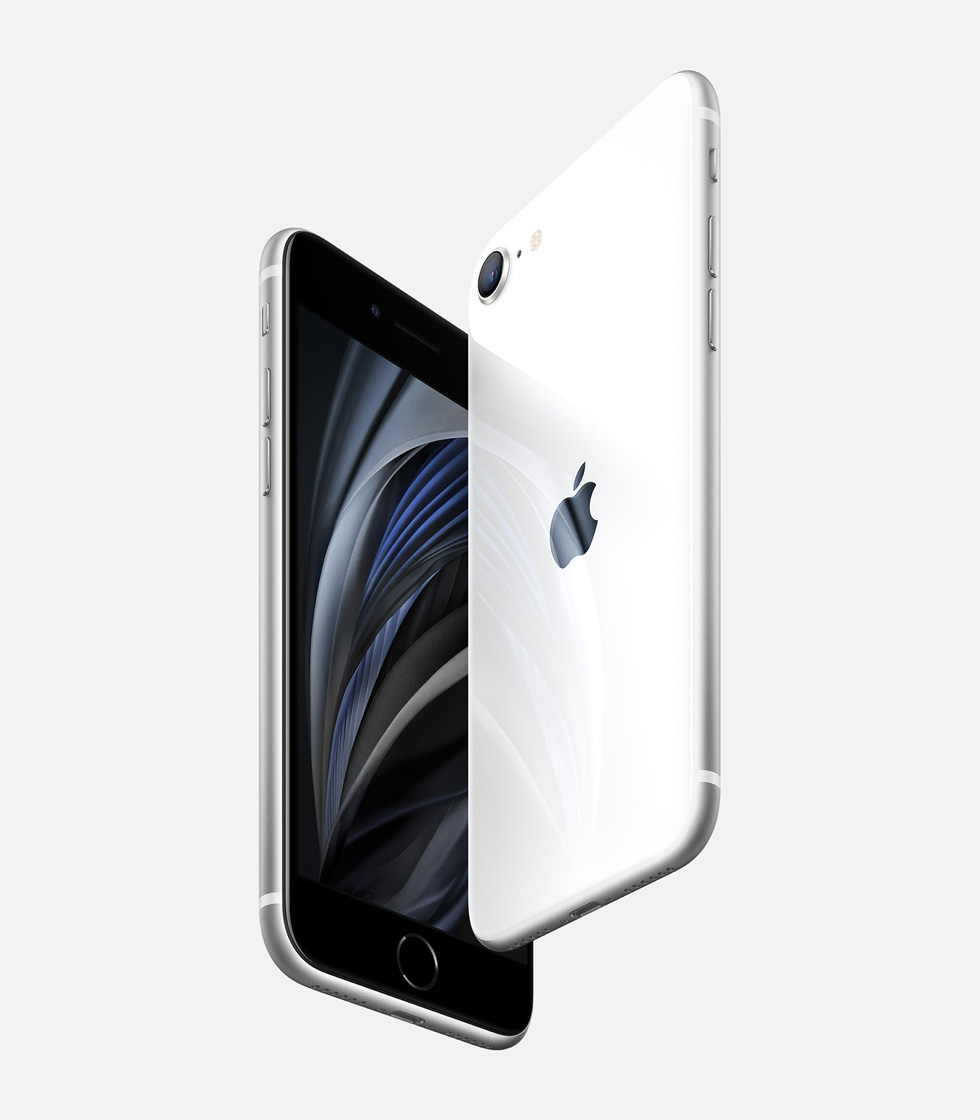
Apple announces the new iPhone SE, its affordable smartphone at 489 euros

Apple announces the new iPhone SE, its affordable smartphone at 489 euros

new-iPhone-SE

     Smoothly, Apple has just renewed its entry-level by introducing a new iPhone SE, which should be powerful, since it will have the same processor as the iPhone 11 and will be sold from 489 euros for 64 GB of storage.

     After the iPad Pro and MacBook Air, it's the iPhone's turn to be updated without any special conference, still because of coronavirus.

     Anyway, the indiscretions were true. The iPhone SE launched in 2016 has finally been upgraded for the first time.

An affordable price

     Available in three finishes, black, white, and (Product)RED, this new smartphone retains its main asset: its price.

     It is sold from 489 euros, without subsidy, for the 64 GB model. For the record and comparison, in 2016, it is the 16 GB model which was at this price ... The 128 Gb model is sold at 539 euros and the 256 Gb model will cost 659 euros.


     Always positioned at the entry-level, it replaces the iPhone 8, which cost 539 euros for 64 GB until now, and the iPhone 8 Plus, which had this role.

     The rumor was about a large iPhone SE model (5.5 inches), for now, no news on this site. But, 2020 is still early.

Compact and powerful, always

     The other advantage of the iPhone SE was its compactness. The new model is a little bigger but keeps the same spirit. It is currently available with a 4.7-inch screen (compared to 4 inches previously) and keeps the design of the iPhone 8.

     So you'll find the borders on the side and top, as well as the Touch ID button at the bottom of the device.

     The larger screen obviously means better definition (1334x750 pixels) than the first model (1136x640 pixels), while the resolution remains the same at 326 pixels per inch. 

     Apple says that this panel should be much brighter and better contrast, the whole difference between a Retina screen and a Retina HD (True Tone and Dolby Vision and HDR10 compatible), so to speak.

     Finally, on the touch side, this new iPhone finishes burying 3D Touch and adopts the Haptic Touch technology to manage finger pressure on the screen and allow access to the "Quick Actions" of iOS.

     Like its elder in its time, the iPhone SE retains its other asset, power. Indeed, it benefits from the best chip of the moment from Apple.

     The A13 Bionic is at its heart. The performance should be very high, even if the amount of RAM onboard will certainly be less than on the iPhone 11 and 11 Pro.

A step forward on the side of the photo     iPhone-XR

     On the photo side, the iPhone SE offers only one rear photo module. It seems very close, if not identical, to the one on the iPhone XR. So there's a 12 Mpixel wide-angle sensor, and a lens that opens at f/1.8.

     The whole should benefit from the neuronal chip embedded in the A13 Bionic, as was the case for the XR in its time.

     In any case, you will be able to film in 4K at 60 fps. Of course, since the iPhone SE comes with iOS 13, you'll be able to take advantage of some new software, including QuickTake, which allows you to shoot a video quickly while in photo mode.

iPhone 12: 4 new models, 5G and a new design

Apple iPhone SE (2020)

Apple-iPhone-SE
SPEC SHEET

TECHNICAL INFORMATION

iOS 13 system


Apple A13 Bionic Processor

Number of hearts 6

Processor frequency 2.65 GHz

Integrated Graphics Chip

Memory card support No

Capacity 64 GB

Protection class (tightness) IP 67

Dual SIM Yes

DISPLAY

Size (diagonal) 4.7 "

LCD technology

Screen resolution 750 x 1334 px

Screen resolution 326 dpi

Refresh rate 60 Hz


INPUTS & OUTPUTS


Wi-Fi support Yes

Standard Wi-Fi Wi-Fi 802.11 n/ac, Wi-Fi 802.11b, Wi-Fi 

802.11g, Wi-Fi 6

Bluetooth support Yes

Bluetooth Version Bluetooth 5.0

NFC Support Yes

Infrared (IrDA) support No

USB Connector Type Proprietary

USB Host Compatibility No

Jack plug No

MULTIMEDIA

The main photosensor 12 Mpx

Flash Yes

Video recording (main) 2160 x 3840 px

Front panel sensor Yes

1920 x 1080 px front sensor video resolution

Front photosensor 1 7 Mpx

COMMUNICATION

GSM bands 850 MHz, 900 MHz, 1800 MHz, 1900 MHz Mhz

Max. reception rate 3G 42 Mbit/s

4G network compatible (LTE) Yes

5G network compatible No

POWER SUPPLY

Removable battery No

Wireless recharge Yes

DIMENSIONS

Width 6.73 cm

Height 13.84 cm

The thickness of 0.73 cm

Weight 148 g
Share:

OnePlus 8 and 8 Pro officially presented: a serious step up the range

OnePlus 8 and 8 Pro officially presented: a serious step up the range

OnePlus-8-Pro

     OnePlus 8 and OnePlus 8 Pro are the new premium smartphones from the Chinese manufacturer.

     Improved design, wireless charging, new features, 5G compatibility... OnePlus wants more than ever to play in the big league, even if it means raising its prices once again.

     We were expecting to discover three smartphones, OnePlus finally announced only two.


     During a video conference broadcast online due to the coronavirus pandemic, the famous brand presented it's OnePlus 8 and OnePlus 8 Pro, the respective successors of OnePlus 7T and OnePlus 7T Pro.

     In addition to being the first OnePlus smartphones to carry the new brand logo, the OnePlus 8 is the first 100% 5G series from the Chinese manufacturer.

Curved screen and sealing

     Last year, the "Pro" model certainly made the owners of the classic model jealous.

     OnePlus' most expensive smartphone had a curved screen, giving it a more modern look.

     This year OnePlus is offering this distinction to its two smartphones. Both OnePlus 8 and OnePlus 8 Pro have a curved screen.

     However, they are not the same size. The classic model has a diagonal of 6.55 inches in 20:9 format, while the ultra-high-end "Pro" model has a large 6.78-inch OLED panel in 19.8:9 format.

     We have to admit that we prefer the small OnePlus 8 which, thanks to its weight of 180 grams and its thinness, is a joy to handle.

     After trying out the pop-up camera last year, OnePlus is returning to something more classic in 2020.

     Both OnePlus 8s conceal their front camera in a tiny punch (3.83 mm diameter) located in the top left corner of the smartphone.

     Why did you make this choice? OnePlus explains that this allows them to make their smartphones watertight.

      Indeed, for the first time, the OnePlus 8 Pro is IP68 certified.

     The OnePlus 8 is also water-resistant... but without certification, because it would have cost too much money.

     The brand, therefore, decided to reserve this argument for the most expensive model, which absorbs costs more easily (note that in the United States, all OnePlus 8 are IP68 certified at the request of T-Mobile, the operator that markets them).

     Another differentiation for the move announced several weeks ago is that OnePlus 8 Pro has a 120 Hz refresh rate display, making its navigation extremely fluid.

     As on the Galaxy S20, we love this new feature! Let's hope that it won't make the battery life drop too much, especially since it's possible to cumulate 120 Hz and QHD+ definition at OnePlus, where Samsung forces the use of Full HD+ on its smartphones to preserve the battery.

     The classic OnePlus 8, on the other hand, only requires a Full HD+ panel at 90 Hz. It's smoother than most competing smartphones but not as magical as the OnePlus 8 Pro.

     Knowing OnePlus, there is no doubt that its successor, the OnePlus 8T, will switch to 120 Hz.

OnePlus 8 colors

In addition to the classic "Onyx Black" color (reflective black glass, as in previous years), OnePlus offers three new matt colors this year.

     Among them are "Glacial Green", "Interstellar Glow" (which reminds us of the Instagram logo), and "Ultramarine Blue", a very successful blue. We salute the efforts of the OnePlus design teams.

     Between the Huawei P40s released a few days ago and the OnePlus 8, we are delighted with this new color variety.

OnePlus likes Google, Google likes OnePlus

     After Xiaomi, it's OnePlus' turn to show its attachment to Google. Do you see this as a provocation to Huawei? You're probably right.

     The proof, on the OnePlus 8 box, is the inscription "with easy access to the Google applications you use the most". The Chinese brand is probably taunting its fellow countryman who is deprived of the Google ecosystem.


     In fact, OxygenOS, the overlay used by OnePlus, is evolving in this direction.

     The OnePlus Shelf menu, which is revealed with a swipe of a finger, on the left side of the device, is giving way to Google

     Discover, which has been requested by fans for a long time. The home screen also provides quick access to Google Duo and Google Assistant.

     The latter is quickly accessible by pressing the unlock button for a few seconds or by making a simple gesture from the lock screen... Finally, with the new OnePlus, you can even play on Stadia.

     In short, as you can see, OnePlus and Google have become much closer this year. To hurt Huawei, this strategy is undoubtedly effective.

Snapdragon 865 and wireless charging

     New year obliges, OnePlus changes processor. The 8 and 8 Pro models use Qualcomm's Snapdragon 865 SoC attached to the X55 modem, making them 5G and Wi-Fi 6 compatible.

     Not surprisingly, these devices are extremely powerful and run all applications without a hitch. Other lighter changes are also present, such as improved haptic feedback.

     Once again, OnePlus offers one of the best experiences on the market.

     Typing on the keyboard or unlocking your smartphone sends very light vibrations, which makes it feel like you are in communion with the device.

     The fingerprint sensor under the display also offers a larger surface area than before, making it easier to unlock your smartphone.


wireless-charging

     The OnePlus 8 has a 4300 mAh battery while the OnePlus 8 Pro, the larger of the two, has a 4500 mAh battery. Is that enough for a 120 Hz and 5G smartphone? Our laboratory tests will determine this.

     According to our initial measurements, it takes 57 minutes to fully charge an OnePlus 8 and 1h02 for an OnePlus 8 Pro with the 30W corded charger provided in the box.

     Of course, the real novelty of this new generation is the arrival of wireless charging.

     Reserved for the 8 Pro model, it allows you to recover 50% of autonomy in 30 minutes using the 30W OnePlus wireless charger sold as an option (69 euros).

     The mobile is also compatible with any other Qi support but, logically, will recharge less quickly with these devices. It can also charge other smartphones or accessories thanks to a 5W reverse charging mode.

     After years of resistance, OnePlus finally goes wireless and offers a truly complete smartphone.

Is OnePlus finally better in pictures?

     Lately, we have been very critical of the camera in OnePlus smartphones.

     We quickly realized that the brand's mobiles were suffering from noticeable slowness and that the quality of the photos was not at all up to the competition.

     OnePlus is aware of this and therefore knows that it is eagerly awaited with this new generation.


     The OnePlus 8 Pro is the most interesting smartphone in this range.

     Like the Oppo Find X2 Pro, it is equipped with Sony's new 48 Mpix IMX689 sensor, which is distinguished by its large size of 1/1.43 inch. This new camera's mission is to improve the quality of low-light shots, and so far, we seem to be delivered pretty much on that promise.

     Initial tests show that the OnePlus 8 Pro is faster than its predecessors (without matching some competing mobiles like the Huawei P40 Pro or the iPhone 11 Pro) but unfortunately it does not offer the quality worthy of an ultra-premium smartphone.

     The OnePlus 8 Pro is also equipped with an ultra-wide-angle module attached to a 48 Mpix sensor (the IMX586 used last year as the main sensor).

     OnePlus adopts a strategy similar to that of its competitors to have better pictures in ultra-wide-angle. This sensor is also used for macro photography.

     There is finally a telephoto lens for an optical zoom x3 (attached to a sensor of 8 Mpix) and, it is a surprise, a sensor dedicated to color filters.

     Of 5 Mpix, it allows Instagram or Snapchat fans to improve their photos before publication. We don't really know how it works yet.


     OnePlus 8 is very similar to OnePlus 7T. It has the same 48 Mpix main sensors as last year, an ultra-wide-angle sensor attached to a 16 Mpix sensor, and a 2 Mpix macro sensor, which is a bit double the size of the ultra-wide-angle sensor.

     We feel that here, OnePlus has mostly put a third photo module to make it look nice ...

     In addition to these hardware changes, let's welcome the arrival of new software features such as an audio zoom similar to that of Samsung and Apple or the "Smart Pet" mode, created to correct slow motion problems.

     The latter allows you to take a picture of a moving object and freeze it, to make the photo usable. It's as if the brand has responded exactly to our criticisms. We'll see if the promise is kept.

Prices are going up... again

     Available from 21 April, the new OnePlus 8s cost more than their predecessors.

     Depending on the brand, these increases are due to the arrival of the 5G.

     The OnePlus 8 will be sold at 699 euros (8+128 GB) or 799 euros (12+256 GB) while the OnePlus 8 Pro will be sold at 899 euros (8+128 GB) or 999 euros (12+256 GB).

     This is still significantly cheaper than the Samsung Galaxy S20. OnePlus even manages to offer its new smartphones 100 euros cheaper than the Xiaomi Mi 10, a token of its good faith towards its fans. 
Share:

Realme 6, Realme 6 Pro: Specification, Price, Release Date

Realme 6, Realme 6 Pro: Specification, Price, Release Date

Realme-6-pro

     Announced on March 5, 2020, the Realme 6 features a Helio90T Mediatek SoC, supported by 4, 6 or 8 GB of RAM, and 64 or 128 GB of storage, expandable by microSD.

     It has 4 photosensors on the back, the main one having a 64-megapixel resolution. It has a 4200 mAh battery and a 30 W fast charge.

     The Realme 6 wants to be a new champion of price/quality ratio and walk on Xiaomi's busy flowerbeds.

Realme 6 design

     Efficient. We can't spend hours describing the beauty of Realme 6 because the praise would ring hollow quickly enough.

     The phone simply relies on efficiency and, in broad outline, it's quite successful. Let's face it: you won't be dealing with a compact smartphone with its 162.1 x 74.8 x 8.9 mm dimensions. It's not the lightest either, weighing 191 grams.

     It's not unpleasant to hold, far from it, but you have to admit that the very slight difference in height between the slab and the edges creates a little discomfort under the finger.

     It is quite easily forgotten, but it is worth noting. The most important thing to remember is that the width of the telephone is considerable.

     Holding the Realme 6 in front of you, you will see a phone marked with a bubble large enough at the top left of the screen to shelter the photosensor from selfies.

     The black outline around the display area is well marked, especially around the thick chin.

     On the back, the plastic surface doesn't really look like glass. It does, however, offer reflections from the center downwards and spread over the entire surface. At least this is the case with our white model.

     Vertical and long, the quadruple photo module is quite imposing and stands out a little bit. The result is a wobbly smartphone when laid flat. Not too much, but still.

     Finally, the fingerprint reader is positioned on the right side, at a good thumb height for a right-handed person, but also for a left-handed person's index finger. At the bottom, the USB-C socket is next to the jack socket.

Realme 6 offers a fairly good display quality 90 HZ

     The Realme 6's LCD screen has a diagonal of 6.5 inches with a Full HD+ definition of 2400 x 1080 pixels. Above all, it has the special feature of being able to achieve a refresh rate of 90 Hz.

     In other words, by activating the appropriate option in the settings, you can make the panel display 90 frames per second to enjoy increased fluidity. It's quite pleasant.

     For the rest, the Realme 6 offers a fairly good display quality. With the CalMAN software and our probe, a maximum brightness of 441 cd/m² is measured, which makes it possible to distinguish what is displayed in a large number of cases.

     Be careful, however, under strong sunlight or in a very bright environment, you will most likely have to squint your eyes to see everything on your screen.

     The contrast of 1381:1 is rather satisfactory, but we can observe that the slab tends to draw a little too much towards the blue.

     This observation is confirmed by our probe which displays a temperature of 7174 K when we aim at 6500 K instead. A gauge in the screen options allows you to correct the shot a little.

     In addition, the slab is not necessarily ultra faithful to reality with an average Delta E of 4.94 on the DCI-P3. We would like this figure to be closer to 3 for more faithful colors, but the Realme 6 is not disappointing either.

     Alas, one will regret a rather limited capacity to display a great variety of colors. Indeed, Realme 6 covers 126% of the sRGB color space while we are more and more used to seeing this number at higher levels. For the DCI-P3 space, which is even wider, the coverage is 84%.

Realme UI home interface based on Android 10

Realme-UI

     The phone takes advantage of the Realme UI home interface based on Android 10. 

    Overall, we see a better overall consistency between the interface elements. For example, all the options in the shortcuts panel are displayed in blue when activated, which was not the case before.

     We have a dark mode - extremely dark - which is no longer simply offered as an experimental function in the Realme Lab menu.

     It is indeed an option to be found in the display settings or via a tile in the shortcut panel.

     Overall, the interface offers a plethora of customizations where you can choose between two gestures navigation systems or arrange the button bar as you see fit, make a thumb-down slide on the home screen bring down the notifications pane, set up a sidebar with shortcuts of your choice, or choose whether or not to opt for an application drawer.

     We won't dwell on the intelligent assistant for long. It simply consists of an additional screen on the home screen that provides quick access to certain functions and displays the number of steps taken.


     It's nice to note that the Realme 6 is certified by the L1 security level of the Widevine DRM. This means that you will be able to enjoy HD quality on SVoD platforms such as Netflix or Disney+.

Realme 6, Realme 6 Pro with 64-megapixel quad cameras 

Realme-6-Pro-64-megapixel

     Four photo sensors are featured on the back of the Realme 6 with the following configuration:

* 64-megapixel (f/1.8) main sensor.
* 8-megapixel ultra-wide angle, 119 degrees (f/2.3)
* depth sensor in black and white (f/2.4)

* sensor with 2-megapixel (f/2.4) macro lens, 4 cm focus point

     With the main sensor, it is possible to take beautiful pictures when the right conditions are present. Colors stand out well while images are correctly detailed.

     In some situations, however, it is felt that the dynamics are not perfectly managed and therefore some areas of the shot maybe a little too much in the shadows. Nothing too bad, though.

     The same sensor also allows you to take full-frame 64-megapixel photos to enjoy a higher level of detail. The difference is there, but it's not usually obvious.

     The pictures are indeed larger, but the precision of the lines and sharpness is not at the expected level. So you won't have much interest in using this mode, which results in heavier images.

     At night, the noise in the images is omnipresent, but one will greet all the same the beautiful efforts of the Realme 6 to offer exploitable images with a level of details, certainly much lower than in normal conditions, but still quite correct for this price segment.

     All the more so as, in a good majority of cases, the light sources are relatively well managed. A good point.

     The night mode can be interesting to better illuminate the shaded areas on the shot. However, on the other hand, colors may suffer from a small yellowing during the process as shown below.

The ultra-wide-angle lens offers by definition a wider field of vision. If the effect of distortion is well attenuated with this shooting mode, you can see that it can fall into the trap of overexposure.

     The colors are also more saturated than in the classic mode. Finally, the level of detail drops noticeably - at night it's even very blurry.

MediaTek Helio G90T - 8 GB

     The MediaTek Helio G90T had already proven its great capabilities on the Xiaomi Redmi Note 8 Pro. On the Realme 6, this SoC, associated with 8 GB of RAM on our test copy, does not fail to maintain this beautiful reputation since it offers very big performances on the phone, especially in-game.

     A part of Fortnite runs extremely well with the graphic details pushed to a high level, 30 frames per second and the 3D resolution set to 100%. It's smooth and seamless. For the price of the Realme 6, it's really a big point of satisfaction.


     Same back to Call of Duty Mobile where you can push the graphics to the max without fear of slowing down your gaming session.

Realme 6 - 4,300 mAh battery

      With a 4,300 mAh battery, the Realme 6 manages to hold up well throughout the day, even when it is used quite actively. It's not the greatest champion in its class.

     With the fairly intense use of mixing games, video viewing, photo sessions, and web browsing, it easily holds up from morning until late at night.


Nevertheless, we could see that Realme 6 runs out slowly, even when taking pictures or videos with it. In-game, it can lose its battery a little faster, but it is still satisfying.

     On a game of Fortnite with all graphics settings set to maximum as well as screen brightness and with the 90 Hz mode, the phone loses about 8% over a 20-minute session. With a more normal set screen, this figure drops to around 5%.

     On a one-hour YouTube video, the phone usually loses 5-6% of its battery, which is very honorable. Realme 6 has proven itself to be quite up to the task in terms of battery life. In addition, the phone comes with a highly efficient 30 W fast charger.

Realme 6  Price and Release Date

     The Realme 6 exists in three versions. Its price starts at 229.90 euros for the model with 4 GB RAM and 64 GB storage. The price goes up to 269.90 euros for the 4/128 GB version and 299.90 euros for the 8/128 GB version.


Start of sales on April 6 
Share:

Huawei P40 Pro: Full phone specifications! the best smartphone without Google?

Huawei P40 Pro: Full phone specifications! the best smartphone without Google?

huawei-p40-pro


     Huawei launches the P40, P40 Pro and P40 Pro+, its three new premium 5G compatible smartphones.

     A year ago, everything was going well in Huawei. The Chinese brand was breaking record after record, enjoying an excellent surge in popularity and offer, with its P30 range, what the press around the world called "the best camera in a smartphone".

     There seemed to be no stopping Huawei, whose destiny was clearly heading for world number one status.

     A year later, much has changed. Having been blacklisted by the United States in May 2019, Huawei can no longer offer Google services on its smartphones, making many applications incompatible with its new devices.

     By a stroke of bad luck, a pandemic struck the world, preventing the brand from holding its major global reconquest conference originally planned for Paris.

     Instead, its new smartphones, the Huawei P40, had to be presented during a live-stream, which is immediately less sexy.

A sumptuous screen

Huawei-P40-screen


     This year, Huawei is offering its P range in three models. In addition to the small P40 (with a 6.1-inch uncurved screen), there are the P40 Pro and P40 Pro+, two smartphones with a 6.58-inch OLED screen.

     A special feature is that the OLED display is curved on all four sides of the smartphone, which is a first.

     This gives the impression of only holding a screen in your hand, although, we'd rather warn you, it's much less impressive in reality than in photos. Still, this new design is quite sublime.

     Importantly, the screen curvature of the P40 Pro is less pronounced than on the Mate 30 Pro. The latter left no room for physical buttons, which is not the case here. The P40 Pro retains volume and power buttons.

     Another new feature, which for the moment only concerns the P40 Pro and P40 Pro+, is that Huawei now offers a 90 Hz refresh rate on its mobile screens. We would have preferred 120 Hz, as on the Galaxy S20, but we'll make do with that.

     We notice from the very first minutes again in fluidity at the level of navigation, which is pleasant.

     On the other hand, it's hard to understand why the Chinese brand chose to insert such a wide punch in the upper left corner of its mobiles. The latter, which contains a front camera (32 Mpix) and a depth sensor, takes up far too much space. A single small camera would have done the trick.

A new, extremely attractive color

     Finally, it's impossible to mention the design of the P40 without saluting the new colors invented by Huawei.

     The color "frosted grey" on the back of our test products is particularly successful. Thanks to the matt glass coating, the back does not catch fingerprints.

     The way the back reflects the light as if we were looking at a cloud, is also to be commended. In all objectivity, it is one of the most beautiful colors of recent years.

     The camera module of smartphones, housed in a rectangle that creates a slight protrusion at the top left, is better integrated into the device than that of other smartphones (Samsung's Galaxy S20 Ultra comes to mind).

     The Huawei P40 Pro+ has a ceramic back. It is clearly intended for those who love more luxurious products.

Kirin 990 5G and ultra-fast charging

     The Huawei P40 belongs to the high-end smartphone category.

     All three are 5G compatible and use Huawei's powerful Kirin 990 processor in its new 5G version with even finer engraving (7 nm EUV). A boosted version of the Kirin 990 that was already found in the Mate 30 Pro. 8 GB of RAM is included.

     Like the P30s, the P40s have a fingerprint sensor under the screen. The latter offers a 30% larger surface area and, according to Huawei, is also faster.

     Our initial tests still find it sometimes inaccurate, even though there is nothing catastrophic about it. The P40s are also the brand's first Wi-Fi 6-compatible smartphones, and Huawei is now moving into eSIM.

     Like Apple, Google or Samsung, the Chinese company offers to set up a virtual package without going to its operator (although the latter must offer such a service). It is still possible to insert two Nano SIMs or a Nano-SIM and an NM card to extend storage.

     The Huawei P40 has a 3800 mAh battery, the P40 Pro and P40 Pro+ have a 4200 mAh battery.

     This seems a little bit right for a high-end 5G smartphone, but the Chinese brand has already proven in the past its excellence in optimizing energy consumption. So let's trust them.

     Finally, the Huawei P40 Pro can handle the ultra-fast 40W charge, while the classic model only needs 22.5W. Only the Pro and Pro+ models are compatible with wireless charging, up to 27W.

Huawei P40 Pro cameras 

Huawei-P40-Pro-cameras

     The Huawei P40, P40 Pro and P40 Pro+ do not have the same camera modules. To make it easier for you to read this article, here's what each of these smartphones offers in terms of camera equipment.

     Let's start with the small Huawei P40. It's a triple camera module that can be found on the back of the smartphone.

     The main sensor, which is a record size (1/1.28", compared to 1/1.33" at Samsung), offers a definition of 50 Mpix (with a lens that opens at f/1.9).

     It uses SuperSpectrum technology, like the P30 Pro. This means that the color filters placed between the lens and the photosensor are RYYB (red, yellow, yellow, blue) and not RGB (red green blue).

     This allows more light to enter the sensor, which improves the quality of night shots. The P40 also features a telephoto lens with a 3x zoom, an 80mm equivalent, which opens at f/2.4 (8MP sensor) and an ultra-wide-angle module that opens at f/2.2, attached to a 16MP sensor.

     The Huawei P40 Pro improves on last year's recipe. It is equipped with the same 50 Mpix sensor as the classic P40 but has three other modules.

     Among them is the same ultra-wide-angle lens as the Mate 30 Pro, with a 40 Mpix sensor attached.

     This extra-large (1/1.54-inch) sensor is also used for video recording functions and offers super slow motion at 7,680 frames per second.

     We'll have the opportunity to test its capabilities further in the near future. There is also a ToF radar dedicated to a depth of field measurement.

     Of course, the Huawei P40 Pro also features an exceptional periscopic zoom, just like its predecessor.

     Attached to a 12 Mpix sensor, it offers 5x optical zoom, 10x hybrid zoom, and 50x digital zoom.

     The main difference from last year is that Huawei has decided to equip its super-telephoto lens with the same SuperSpectrum technology as its main sensor.

     The promise: to allow you to take night shots from far away without any degradation in quality.

     Our first tests are quite disappointing, there are big problems with white balance management (hopefully Huawei will fix them in a future software update).

     On the other hand, let's salute the smartphone's foolproof optical stabilization. On one hand, even at 50x zoom, the image is not degraded by any shaking. Like Samsung with its Galaxy S20 Ultra, Huawei hits hard.

     Finally, with its Penta camera module, the Huawei P40 Pro+ is the most impressive mobile phone ever announced by the brand.

     The smartphone shares with the P40 Pro it's 50 Mpix main sensors, 40 Mpix ultra-wide-angle and ToF sensor but differs in terms of zoom.

     In fact, it has two. In addition to a telephoto lens with a 3x zoom (like the classic P40), this camera comes with the first periscope with... 10x optical zoom.

     Attached to an 8 Mpix sensor (also SuperSpectrum), this one can go up to 100x digital.

     The most mocking people will say that Samsung does the same with its S20 Ultra but let's remind them that Korean's mobile phone only has a 4x optical zoom. Chances are that Huawei's phone is much better.

     There are also a few new features common to all three smartphones, such as new algorithms for portrait mode (which improves skin color accuracy) and a glare removal system. A new mode similar to Apple's Live Photo also allows you to record a short video before and after taking a picture to keep more memories.

Software, always the Huawei's ball and chain

AppGallery-huawei-p40


     As incredible as these Huawei P40s are, remember that these smartphones are deprived of Google services. This poses huge problems to the use.

     For example, in the first configuration, it is impossible to recover many applications from your old smartphone.

     All Google, Facebook, Uber, etc. apps are grayed out... If you want to get them back yourself, by downloading their APK, you will then discover that they don't all work.

     Citymapper, Uber, YouTube, Yuka, PathéGaumont, to name but a few, don't boot on the Chinese giant's new devices (they use Google APIs, which are absent from this smartphone).

     Instead, Huawei recommends that you go through your browser and opt for their web versions. It works, but do you really want a smartphone that's incompatible with a bunch of popular applications?

     In the long term, Huawei is banking on its HMS (Huawei Mobile Services) to fill the gap. Many apps reach its AppGallery app store every day, even if, let's face it, it is still very empty today.

     Next to the Play Store, it looks really pale (especially since there are some very strange interface bugs, like texts written in Chinese.

     New for 2020, when the AppGallery doesn't have the application you're looking for, it can redirect you to its publisher's site or third-party platforms.

     However, this solution has one important negative point: your applications won't be updated by themselves.

     Instead, we recommend that you opt for third-party stores such as the Aurora Store, even if, once again, nothing tells you that an application will work once it is installed.

     Getting a Huawei smartphone these days is a bit of a lottery. Fortunately, the brand promises many improvements in the course of 2020, including a notification system to alert you when APK updates the installed applications when they become available.

     Another novelty introduced with the P40s is that Huawei replaces Google's search engine with Qwant's search engine.

     The brand is also launching its video calling service MeeTime (a competitor to FaceTime and Google Duo) and Huawei Music, its competitor to Spotify (with three months free and then a subscription at 9.99 euros per month).

Huawei p40 pro price

     As it stands, we find it difficult to recommend the P40 range. Marketed respectively at 799 euros, 1099 euros and probably more than 1300 euros for the top of the range if it arrives in France, the Huawei P40, P40 Pro and P40 Pro+ still encounter major software problems and are not intended for all audiences.

Can Huawei make it?

Huawei has assured us that a VIP hotline for customers of these devices will answer all their questions about installing applications.

     We still find this difficult to manage in the long term. Moreover, according to our information, Google would now remotely block the clandestine installation of its services on Huawei devices... Can we create the best smartphone in the world without Google?
Share:

Labels

Recent Posts

Unordered List

  • Lorem ipsum dolor sit amet, consectetuer adipiscing elit.
  • Aliquam tincidunt mauris eu risus.
  • Vestibulum auctor dapibus neque.

Pages

Theme Support

Need our help to upload or customize this blogger template? Contact me with details about the theme customization you need.